Guide · 6 min read · Updated
Wedding in Mallorca if it rains:the plan B
Six things to settle with the venue while the sky is still blue.

What happens to a wedding in Mallorca if it rains depends on what was decided weeks before, not on the rain. And it is not only an autumn matter. According to AEMET's climate normals for Palma Airport (1981-2010), September is the month with the most thunderstorm days of the year, 3.9 on average, and even July, the driest, averages 0.5 days of rain a month: an average is not a guarantee. The full month-by-month table is in when to marry in Mallorca and Ibiza. Here we deal with something else: what needs to be decided, in writing, before the day.
Who decides the change, and when
The most important question is the least romantic: who says "we are moving inside", and at what time. If nobody has set it, it is decided by the nerves of the moment, with the ceremony about to start and a hundred people looking at the sky.
Ask the venue or hotel for a cut-off time, in writing: the moment after which the change is no longer up for discussion. It has to fall before the set-up, not before the ceremony, because moving chairs, flowers and sound takes time you need to know. Ask also who decides (the venue, you, a trusted person you name) and on what information. And if you are thinking of insurance in case the weather fails: wedding insurance. AEMET, Spain's state meteorological agency, publishes weather warnings and forecasts by municipality and for beaches; agree beforehand which one is looked at, so that nobody decides from a phone app.
And who tells everyone else: suppliers, transport and guests. A change of plan that never reaches the person driving the coach becomes a different problem.
There is one case almost nobody asks about: what to do if the rain starts with the ceremony already under way. It can be interrupted and moved, carried on for a few minutes with the sky threatening, or shortened. There is no right answer, but someone should have thought it through, and whoever officiates, photographs and films should know what it is. Ask also about the cocktail: whether it moves along with the ceremony or waits to see if it clears.
The covered space: capacity, time and light
The plan B is not a place, it is three facts: how many people fit seated, how long it takes to move from one space to the other, and how much light it has. Ask for the seated figure, not the cocktail one, and for it to be stated separately for the ceremony and for dinner: a hall can work for one and not the other.
- Who sets up the change, with how many staff and in how long.
- Whether the ceremony and dinner can share a hall, and what happens to the chairs between the two.
- Whether the space has windows or natural light, and which way they face.
- If the plan B is a marquee: whether the property already has one or it has to be brought in, from which day it is ready, and whether any paperwork is needed.
- If the plan B is another building: how guests get there, on foot, by car or by coach, and which road is left.
The cocktail is usually the hardest part to solve: it is when everyone is standing, moving about and looking for air. If the plan B only has room for seating, ask where the cocktail would be held, or whether bringing dinner forward is proposed. A plan B that solves the ceremony and leaves the cocktail in a corridor has a gap.
Sound and flowers
They are the two suppliers who suffer the change most and who are least often in the conversation. On sound, ask how the ceremony is amplified (speakers, microphones, someone playing live), which part stays under cover if it rains and who moves it. Outdoor equipment does not move in five minutes, and a closed hall changes how a voice sounds. If there is live music, ask whether the instrument tolerates damp and where it is placed.
On flowers: the arch, the centrepieces and the aisle. Talk to whoever prepares them about what moves, what stays outside and whether a second, smaller set-up is planned for indoors. A florist who knows the plan B from the start designs for both scenarios; one who finds out the day before improvises.
Light and photos under cloud
An overcast sky does not ruin the photographs or the film: it changes them. The light is softer, there are no hard shadows on faces or guests squinting, and colours look quieter. What is lost is the golden backlight of the end of the afternoon, which we explain in the light of the island; if you had it in mind, know that on the day it may not arrive.

Indoors, light depends on the windows. A hall with tall windows in mid-afternoon can be a better place for the ceremony than a grey garden, and one without windows the worst. So the question is not only how many fit, but where the day comes in. If you already know which area you are marrying in, the guide by area explains how the afternoon changes from a valley to a coast.
Ask for a corner by a window in the plan B for ten minutes alone with your partner, and talk to whoever photographs and films your wedding about what to do if the sky changes mid-afternoon: you can wait for a clearing or make use of the interior, and it is better to have talked it over than to decide at seven in the evening with everyone watching.
Wind: open air and coast
Wind is the guest who announces himself least. The AEMET climate normals we have used do not include wind, so we give no figures: what follows is judgement, not statistics.
In wind, the open air does not need a full plan B but adjustments. The arch has to be well fixed, tall centrepieces and candles become a problem, the veil and the papers fly, and a microphone without a cover records the wind throughout the ceremony. Ask whoever sets up what they have planned for that. And if the wind is strong, words are harder to hear: talk to whoever officiates, and to anyone reading at the ceremony, about whether they prefer to use a microphone or stand closer to the guests.
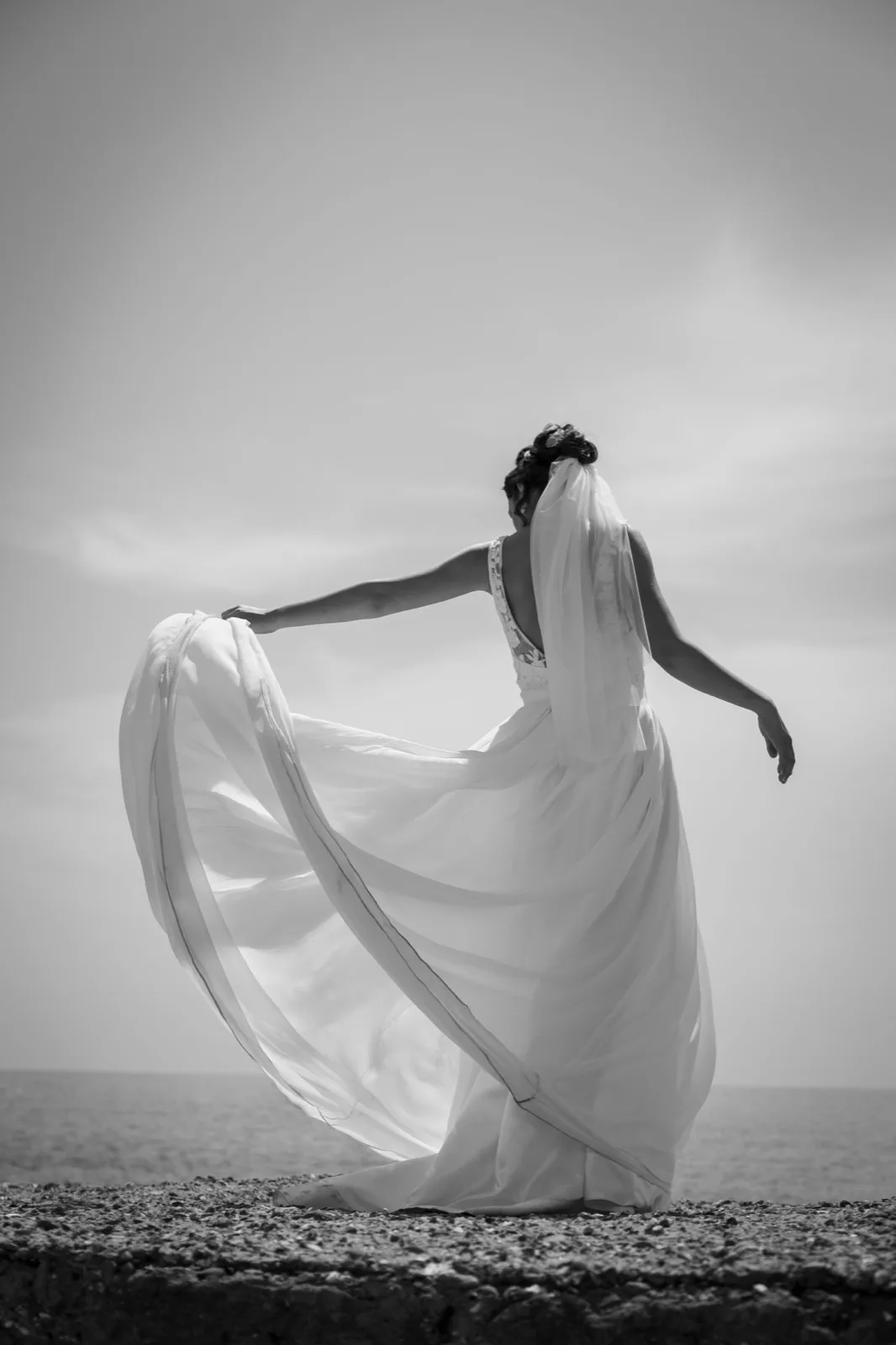
By the sea, if nothing slows it down, the wind arrives in full, and the exact spot of the ceremony matters. Ask what is around that gives shelter (a wall, a hedge, the house itself) and which corner it would be if you have to move a few metres. On the west coast, the light of the island speaks of the late-afternoon westerly. On confetti in the wind and how to angle the exit aisle, there is a separate guide.
What to have in writing
Put it all in a single email to the venue, and keep the reply:
- Who decides the change, on what information and what time the cut-off is.
- The covered space: seated capacity for the ceremony and for dinner, and how long it takes to set up.
- Who tells guests, transport and suppliers if the plan changes.
- What moves and what stays, for flowers and sound.
- What windows the indoor space has and at what time it gets light.
- What is done if wind rules out a part (candles, arch, music) even without rain.
If you do not have a venue yet, start with the estates by area. And if you already have a date and a venue and want the plan B to include whoever photographs and films, you can tell us your story. On the eve: what to settle the day before the wedding.
Frequently asked questions
What happens to a wedding in Mallorca if it rains on the day of the ceremony?
It depends on what was agreed. If there is a covered space, a cut-off time and someone who decides, the change is just another set-up; if not, it is decided in a rush. Ask the venue for those three things in writing before fixing the date.
Does it rain much in Mallorca in summer?
Little. According to AEMET climate normals for Palma Airport (1981-2010), the average is 0.5 days of rain in July, 1.7 in August and 1.8 in June, counting days with 1 mm or more. It is a thirty-year average, not a forecast, and late-summer storms count too.
Can you get good photographs under an overcast sky?
Yes. The light is softer and without hard shadows, which flatters portraits. What is lost is the golden backlight of the end of the afternoon; it is worth agreeing beforehand on a corner with window light for the couple's session.
What if it does not rain but it is windy?
It is another plan B, a smaller one: fix the arch, avoid tall centrepieces and candles, protect the microphones and choose a ceremony spot with shelter. Ask whoever sets up what they have planned.