Guide · 6 min read · Updated
Confetti at a wedding:what you may throw and what to ask
What to throw, where and when: a moment of seconds that is settled in writing.

Confetti at a wedding is one of the most photogenic moments of the day and also one of the ones most worth discussing beforehand: what is thrown, where it lands and who clears it up depends on the venue and, if a beach or open countryside is involved, on rules that cannot be improvised. This text sets out what is usually admitted, what to ask in writing, when it is thrown and how it looks in photographs and on film.
Choosing the place is a separate decision, covered in where to hold a wedding in Mallorca; here only what that place lets you throw matters. And with rain or wind the plan changes, as explained in the rain and wind plan B.
What to throw, and what not to
Three families of things are usually thrown: petals and leaves, paper confetti and, less often, grain or seeds. Each venue has its own list, and almost all begin with the same sentence: no plastic, no glitter.
- Petals and leaves. Fresh or dry, and preferably undyed. They sweep up easily and sit comfortably in a garden. On steps or polished floors a damp petal slips: tell whoever officiates and whoever is walking in a long dress.
- Paper. Light and not metallic. If it is sold as “biodegradable”, do not settle for the word: ask what it is made of and let the venue say whether it admits it.
- Grain and seeds. There is no general rule here: the venue decides. Ask, and do not assume that what one allows another will.
- What to avoid. Plastic, metallic foil and loose glitter. They do not sweep up well and stay on the ground and in the water.
There is no need to be dramatic about plastic, but it pays to be exact: Spain’s own national waste law recalls that plastic products, once abandoned, degrade very slowly and end up fragmented into tiny particles. That is one of the reasons many venues exclude it.
What venues usually ask for
Conditions vary from place to place, but they repeat: outdoors only; in one area only, the one where you leave the ceremony and not the whole garden; only material the venue approves or supplies itself; nothing near the pool, indoors or on the lawn people walk on afterwards. And, sometimes, a cleaning charge, or the obligation to pick up whatever falls.
The reason is not whim. The law defines scattered litter as waste that ends up abandoned in natural or urban spaces, and treats the cadastral owner of the plot where abandoned waste appears as its holder, unless whoever left it can be identified. Put plainly: if nobody collects what falls, the person responsible becomes the owner of the place. That is why the answer is usually a short, strict list.
Beach and countryside: other rules
The coastal law, which we summarise in the article on where to hold the ceremony, declares the common use of the sea and its shore free as long as it requires no works or installations, and always in accordance with the applicable laws and rules, and says that beaches are not for private use. Two things follow: nobody can promise you an empty beach, and free use does not mean anything goes. What the town council has said about waste on its beaches is its own business, and the answer is asked of it.
In the countryside or on sand there is also a simple fact: what falls stays. Collecting paper confetti afterwards from gravel, stone or tall grass is far harder than from a hard floor, and what nobody collects ends up in the surroundings and in animals’ mouths. If the place is a protected space, ask whoever manages it as well. And bear in mind that, for waste managed by the municipality, penalising abandonment is up to the local authorities: the town council is the one that watches it.
What to ask, in writing
The same questions, by email, to the venue and, if it is a beach or public land, to the town council as well. The written reply is then passed to whoever hands out the material and whoever coordinates the day:
- May anything be thrown, and what exactly: petals, paper, grain?
- At which point, and which areas are excluded: indoors, lawn, pool, sand?
- What do you mean by biodegradable, and who approves the material?
- Who clears it up, and is there a charge?
- Whose land is it thrown on, and who says so in writing?
- What changes if it is windy or raining?
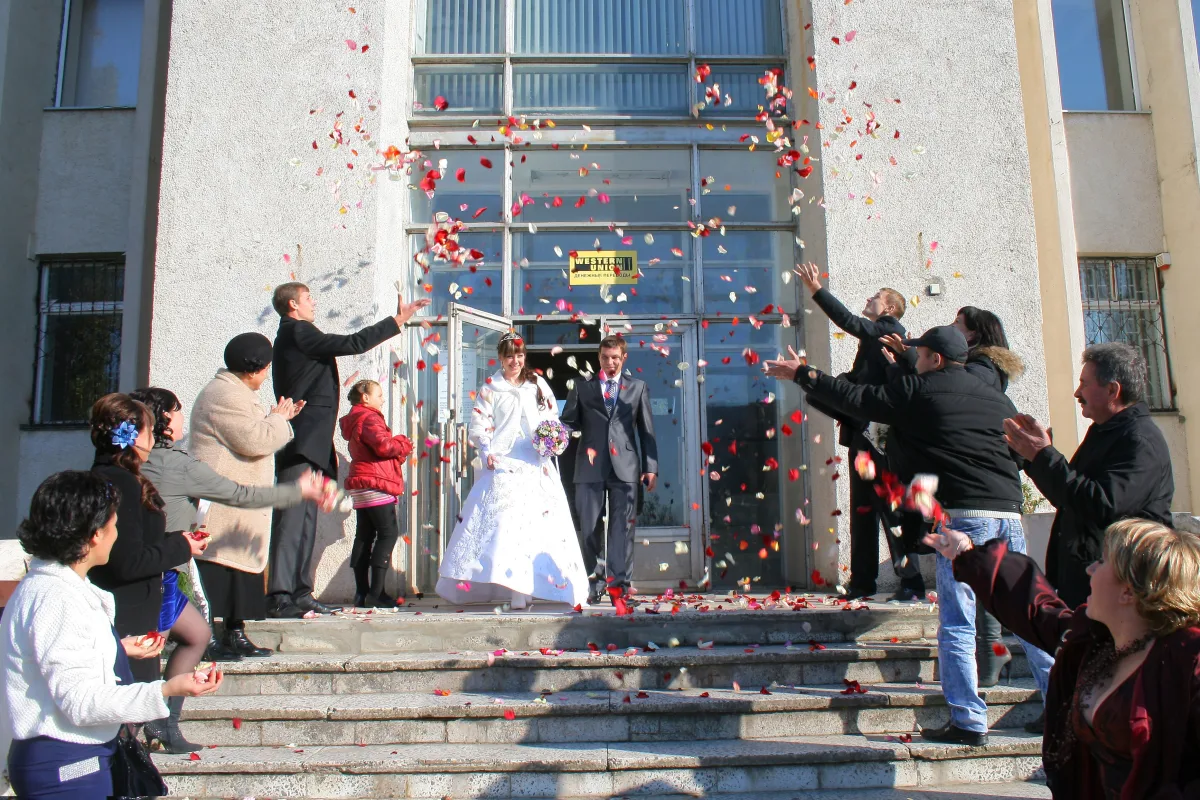
When: as you leave the ceremony
Confetti is thrown when the ceremony ends, as the couple walk out along the aisle or through the door, and it lasts seconds. Three things make it work. A trusted person hands the material to the guests before the ceremony finishes, in a small basket or paper cones, so that nobody carries it in a bag. The couple know how far they have to walk and which way. And the group portraits come afterwards, not before: with everyone standing and together, the next step is the family photos. Noise and animals: pets at the wedding.
If the venue allows it, some people repeat it on arriving at the dinner or the dance. There is no need: once, well prepared, looks better than twice improvised.
How it looks in photos and on film
It is an instant that happens once. That is why how it is organised matters more than how much is thrown. What helps most:
- A short, clear aisle. Guests on both sides and nobody in front. Someone filming on a phone in the middle of the path blocks the couple and shows up in every image.
- A throw on command. A countdown instead of a trickle: everything falls at once and fills the frame, and the film picks up the laughter and applause of the moment.
- Light, pale material. With the sun behind, a petal or light paper catches the light and reads; in shade it barely shows. White is lost against a white wall.
- Up, not at the face. At shoulder height and upwards. It bothers the eyes and the veil, and the couple’s faces are what the photograph is about.
- Plenty of material. Whoever receives nothing throws nothing, and the empty sides of the aisle show.
Wind changes the pattern: it carries the confetti towards the couple or towards whoever is behind. It is solved with the direction of the aisle, which is checked on the visit, and talked through with whoever coordinates the day. What else to settle for wind is in the plan B.
How to settle it
One written paragraph is enough, read by everyone involved: what is thrown, at which point, who hands it out and who clears it up. With the venue’s reply, and the town council’s if it is public space, in the same folder. If you would like us to work that moment into the day with you, tell us your story. What we do and how we work is in wedding photography.
Frequently asked questions
Can confetti be thrown at any wedding venue?
No. The venue decides: many admit only petals or light paper, in one defined area and almost never indoors. Ask in writing what they admit, where, who clears up and what happens in wind.
Which confetti is best for a wedding?
Light and plastic-free: petals, leaves or non-metallic paper. If it is advertised as biodegradable, ask what it is made of and let the venue say whether it accepts it. Avoid plastic, metallic foil and loose glitter.
Can confetti be thrown on the beach?
It depends on the town council and the applicable rules, not on the couple. The coastal law declares the common use of the sea and its shore free without works or installations, but beaches are not for private use and nobody collects what falls. Ask the town council first.
When is confetti thrown at a wedding?
As you leave the ceremony, when the couple cross the aisle or the door. It lasts seconds: hand out the material beforehand, settle the spot and leave the family photos for afterwards.