Guide · 6 min read · Updated
Outside catering at a Mallorca weddingand music: what to ask the house
Two questions that change the day, and how to put them in writing before you fall for the house.

Outside catering for a wedding in Mallorca comes down to two questions that change the day, and it is worth asking them before you fall for the house. The first is whether the house allows a caterer other than its own, or has one of its own; the second, how late and how loud music can be. The menu depends on them, and so do the time of the toast, the time of the last song and when the night ends. We will not repeat here how to choose a place, which you have by type of place and by area, nor how to look for a team from outside the island, which is in wedding suppliers in Mallorca. This is what comes next: two questions and how to put them.
First question: the house caterer or an outside one
A single house can answer in three ways, and it helps to know which before talking about menus. It may have its own kitchen and require that it be used; it may allow others, but only from a list of companies it already knows; or it may let you choose freely, sometimes in return for a fee for using its facilities. None is better in the abstract. The house kitchen saves you coordination; free choice lets you bring someone you already know, or someone who cooks what you want to eat. What matters is that they tell you in writing, because this condition often does not appear in the venue's brochure.
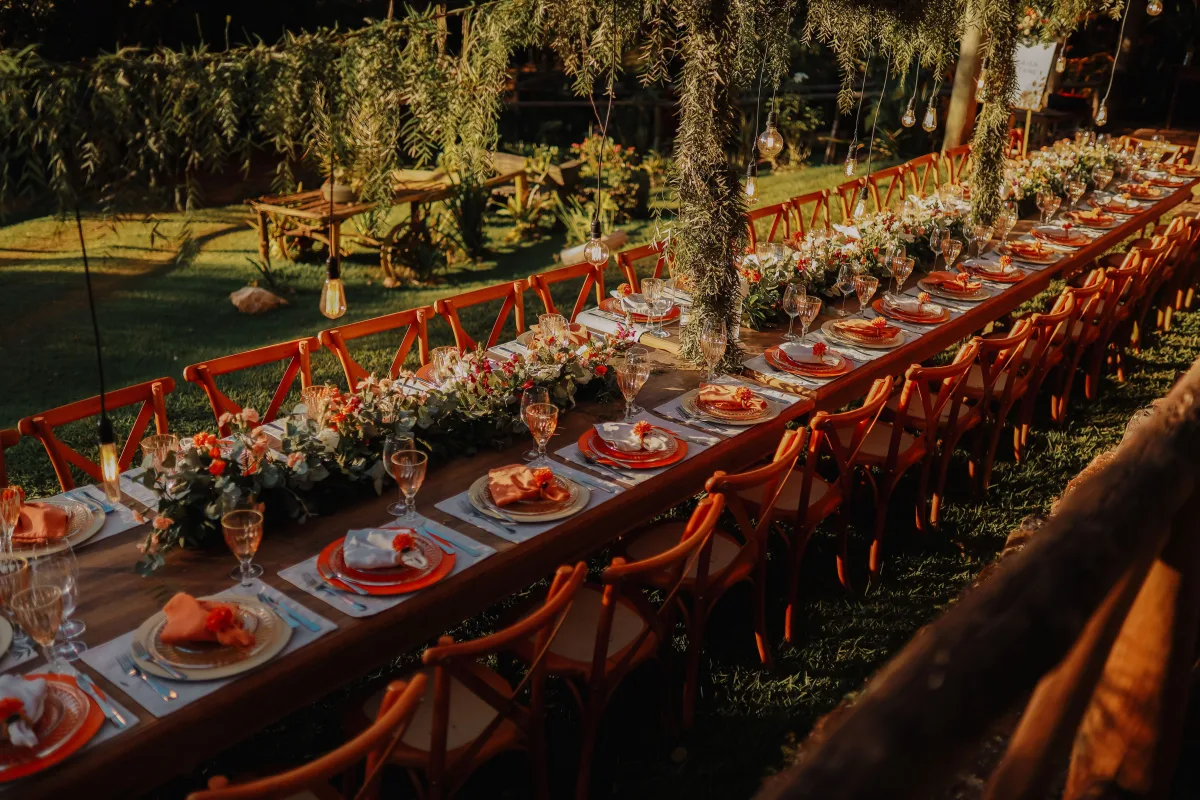
If the house has its own caterer, ask:
- Whether the menu is fixed or adapts to your guests, with allergies, diets and children, and until when the guest list can change.
- What the service includes: tables, chairs, linen, crockery and glasses, and who clears them at the end.
- Until what time it serves and when the staff leave.
If it allows an outside one, ask:
- Whether there is a list of companies or you can bring your own, and whether bringing one means a fee or an added condition.
- What there is for the service: kitchen or set-up area, water, electricity and refrigeration, or whether the caterer must bring everything.
- When they can come in to set up, when they must have finished clearing and how they get in: track, vans, coach.
- Who takes away the waste and leaves the space clean.
- Who answers if something goes wrong between the house and the caterer on the day; it is better to have one name than two.
One piece of official information applies to any caterer, the house's or an outside one. The Balearic government points out that the duty to register food businesses comes from Regulation (EC) 852/2004, and it publishes a register of food establishments with a search tool to consult it. Ask the company for its health registration details and check them. It does not replace a visit or a tasting, but it is a check almost nobody makes and it takes a single email.
From the point of view of the images, this first answer matters for a practical reason: the time dinner is served sets when the toast, the speeches and the dancing happen, and an outside service arriving at a house for the first time does not know its rhythm. Ask whether the caterer has already worked at that place, as you would with any other supplier.
Second question: how late, and how loud
Music is the other half, and here the answer does not come from the house alone. The Balearic law against noise pollution, Law 1/2007, gives town halls the job of approving their ordinances, checking they are followed and penalising when they are not, and lets those ordinances be stricter than the law's minimums. In practice, two houses on the same island can have different music hours, because they do not answer to the same town hall. There is no single island-wide hour; there is the hour of each place.
Sound limits and the time until which there can be music are set by the venue's licence and the town hall's ordinance: ask in writing. The hour at which the music stops is set by the house's licence and by what its municipality provides, and that can only be found out by asking.
For open-air events with music, the law itself provides for a prior acoustic study when the sound or the number of people exceeds certain thresholds; we explain that step in what a town hall decides, and do not repeat it here. What matters here is what to ask the house.

Ask, in writing and in the same words of everyone:
- Until what time music may play outdoors and until what time indoors, and whether they differ.
- Who sets that time: the house's licence, the municipality's ordinance or both, and in which document it appears.
- What happens at the cut-off: whether everything stops, or the party carries on in a closed room, or with a different kind of sound.
- Whether the house measures the sound during the party, who watches it and what it does if the level is exceeded.
- Whether it distinguishes between a live band, a DJ and speakers with a playlist, and whether it asks for advance notice from the sound team.
- Whether there are neighbours nearby or another event that day, and whether that changes anything.
- Whether that time is in the contract or is only the house's habit.
Ask also for the name of whoever authorises it. A phrase like “it usually ends late” is not an answer; a written time, with its source, is. To order the speeches with the music and the service, see this guide.
Where the two meet
The two questions touch at one point: the end of the night. An outside caterer usually packs up when service ends, and the music decides when the last guest leaves. If the house sets an early sound cut-off and the caterer must clear everything before a certain time, the room for dancing narrows. And the other way round: a house with flexible hours for service solves nothing if the ordinance cuts the music earlier. It helps to draw the whole night with both times in view, counting back from the cut-off, and check that everything fits.How that part of the night is prepared for the photos: wedding party photos.
For photography and film it is the most useful piece of information: knowing when the party ends lets us decide when to be there and when it is not needed. If, once you have the answers, you want to compare two or three houses, you can tell us your story.
Email template
Copy it, change the details in brackets and send it, identical, to every venue. Keep the replies in a single document.
Subject: Questions about catering and music for our wedding on [date]
Good morning: we are considering your house for our wedding on [date], with about [number] guests. Before going further, could you answer these questions in writing?
- Does the house have its own caterer, allow an outside one, or work with a list of companies?
- If it allows an outside one, is there a fee or any added condition?
- What is there for the service: kitchen or set-up area, water, electricity and refrigeration?
- When can the team come in to set up and when must they have finished clearing?
- Until what time may music play outdoors and until what time indoors?
- Who sets that time, the house's licence or the municipality's ordinance, and in which document does it appear?
- What happens at the cut-off?
- Is there any difference between live music, a DJ and speakers?
Thank you very much. We look forward to your reply.
Frequently asked questions
Can you bring your own caterer to a house in Mallorca?
It depends on the house. Some require their kitchen, others allow only companies from a list and others let you choose, sometimes with a fee for using the facilities. There is no general rule: ask them all in the same words and ask for the answer in writing.
Who decides how late music can play?
Balearic law against noise pollution leaves ordinances, enforcement and penalties to town halls, so the time depends on the venue's licence and its municipality. Ask for it in writing, with the name of whoever authorises it.
Does live music count the same as a DJ?
The law speaks of sound sources and the levels that reach the surroundings, not of musical genres. The prudent course is to ask the house whether it distinguishes between a band, a DJ and speakers, and whether it asks for advance notice from the sound team.
What should you ask an outside caterer for?
Its health registration details, which you can check in the Balearic government's register of food establishments; whether it has already worked at that house; when it needs to come in and leave; and what it expects to find in the kitchen or service area.